




PIC / PDP : Principes, enjeux et pilotage

In an environment marked by market volatility, supply chain pressures, fluctuations in demand, and heightened customer service expectations, industrial companies must have robust management processes in place to effectively align sales, production capacity, and available resources.
The Industrial and Commercial Plan (ICP) and the Production Master Plan (PMP)
Two key processes help maintain this balance:
- The PIC (Industrial and Commercial Plan),
- The PDP (Production Master Plan).
These two closely interrelated and sequential levels of management are complementary and form the core of the process S&OP (Sales & Operations Planning)within the model MRPII (Manufacturing Resource Planning)as shown in the following diagram.
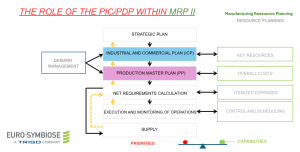
The PIC operates at both the macro and tactical levels, anticipating capacity needs and strategic trade-offs, while the PDP translates the guidelines set out in the PIC into a detailed and actionable operational plan as close to the ground as possible.
More than just a planning exercise, the PIC/PDP combination serves as a genuine decision-making tool that helps balance the company’s economic, industrial, and commercial priorities.
The PIC: Balancing Market Demand and Industrial Capacity
The PIC is a tactical planning process designed to balance:
- Sales forecasts,
- Production capacity (equipment and human resources),
- Inventory,
- Financial targets (revenue, margin, cash flow).
The PIC typically covers a 12- to 24-month period with monthly breakdowns. Its primary objective is to answer the following questions:
- What will the company sell (firm orders, sales forecasts)?
- What can it produce? Is current capacity sufficient?
- What internal and external resources need to be mobilized?
- What economic trade-offs need to be made? etc…
This makes it possible to anticipate future challenges and make strategic decisions before operational constraints become critical.
The reliability of forecasts: a major challenge
The quality of the PIC depends directly on the reliability of sales forecasts. To achieve this, high-performing companies implement statistical models, historical analyses, demand scenarios, digital forecasting tools, and a collaborative process involving Sales and Supply Chain—and sometimes key customers.
Key output data from the PIC
In particular, the PIC generates:
- An aggregated production plan,
- Overall inventory targets,
- Macro-level capacity decisions,
- Load/capacity trade-offs,
- Investment decisions,
- Decisions regarding subcontracting or outsourcing.
The PDP: Translating the PIC’s Guidelines into an Actionable Production Plan
The PDP serves as the operational implementation of the PIC. It translates the overall objectives defined by the PIC into production orders, detailed quantities, production schedules by item, component and material requirements, and production priorities.
The PDP typically operates on a shorter time horizon—ranging from 3 to 12 months—with weekly monitoring.
The PDP has several objectives:
- Ensure customer service levels,
- Smooth out production workloads,
- Prevent stockouts,
- Optimize inventory,
- Coordinate purchasing, production, and logistics,
- Ensure on-time delivery.
The PDP thus serves as the point where business needs and the plant’s operational reality converge.
A practical example of how the PIC/PDP works
Let’s take the example of an automotive supplier that manufactures braking systems for several automakers. Following the launch of a new vehicle by one of its customers, the company anticipates a gradual 25% increase in volume over the next six months.
The PIC will make it possible to anticipate the overall impacts of this ramp-up:
- assessment of production line capacity,
- forecasting labor requirements,
- securing critical supplies (steel, electronic components, machined parts),
- analysis of supplier capacity,
- deciding between in-house production and outsourcing,
- adjusting safety stock levels.
The PIC will also help identify potential industrial risks:
- line capacity constraints,
- stress on certain components,
- the need for additional investments,
- or the temporary use of extra staff.
Decisions made at the PIC level will thus help secure industrial capacity several months before the actual increase in demand.
The PDP will then translate these guidelines into detailed operational plans. In particular, it will enable:
- sequencing of production orders by part number,
- organizing changeovers,
- smoothing out shop floor workloads,
- synchronizing supplier deliveries,
- adjusting production schedules on a week-by-week basis, and ensuring compliance with manufacturer deadlines.
In the automotive industry, where production flows are highly synchronized and service requirements are extremely high, the PDP plays a central role in preventing: delivery disruptions, production line stoppages at the manufacturer, excess inventory, and associated logistics penalties.
How can you effectively manage the PIC/PDP?
PIC/PDP management requires cross-functional governance involving, at a minimum: Senior Management, Sales Management, Industrial and/or Operations Management (Production, Supply Chain, Purchasing), and Finance Management.
The objective is to ensure constant alignment between sales strategy, manufacturing constraints, and financial performance.
Management must enable the rapid identification of: overloads, bottlenecks, supplier risks, capacity deviations on the shop floor, and logistical pressures.
The main levers for adjustment include: overtime, outsourcing or subcontracting, inventory adjustments, production smoothing, industrial investments, order prioritization, and enhanced collaboration with strategic customers.
The main factors contributing to deviations from a PIC/PDP
In many companies, the challenges do not stem from the tools themselves but from a lack of discipline or governance. The main causes of failure observed are:
- unreliable data,
- forecasts that haven’t been sufficiently challenged,
- constant changes in sales,
- a lack of decision-making coordination,
- silos between Sales and Production,
- an ERP system that’s been poorly configured,
- a lack of adherence to the PDP,
- low supply chain maturity.
The PIC/PDP must remain a genuine decision-making process and not merely an administrative planning exercise.
The Digital Transformation of the PIC/PDP: Toward Enhanced Management Tools
Industrial companies now rely on advanced digital tools to improve the robustness of their management processes. Modern solutions enable, in particular:
- automated forecasting,
- scenario simulation,
- real-time capacity analysis,
- demand sensing, to capture real-time changes in market demand,
- financial integration,
- the use of artificial intelligence to improve demand forecasting.
Advanced Planning Systems (APS) and advanced supply chain management solutions significantly enhance the responsiveness and decision-making quality of PIC/PDP processes.
In summary:
The PIC and the PDP are two key pillars of industrial management and supply chain management.
- The PIC helps align business strategy, manufacturing capacity, and financial goals.
- The PDP translates these guidelines into a detailed production plan that is feasible and can be managed on a day-to-day basis.
In an increasingly volatile and demanding industrial environment, mastering the PIC/PDP torque ratio is becoming a major competitive advantage.
Effective management relies in particular on:
- collaborative involvement of the company’s various departments,
- data quality,
- load/capacity management,
- high-performance digital tools,
- and robust supply chain governance.
|
Comparative Overview of the PIC and the PDP (Standard Version) |
||
| Criteria | PIC | PDP |
| Horizon | 12–24 months | 3–12 months |
| Level | Tactics | Operational |
| Granularity | Product families | Article references |
| Frequency | Monthly | Weekly |
| Objectives | Balancing demand and capacity | Run the production |
| Steering | General Management / Sales
/ Industrial |
Operations / Production / Supply Chain |
| Possible link | Supply Chain Coordinator | |
Further reading
The Euro-Symbiose Training Program #91 “Effectively Managing the PIC/PDP Process”, is based on a real-world case study and provides a detailed understanding of the challenges, best practices, and key factors involved in implementing a robust and effective PIC/PDP process: View the program and register
📞 Une question ? Nos équipes sont à votre écoute et votre service pour répondre à vos besoins :
- France : +33 (0)2 51 13 13 00 – service.clients@euro-symbiose.fr
- Maroc : +212 (0)6 91 00 06 46 – service.clients@euro-symbiose.ma
